


Did you know that cross-border commercial disputes can involve the laws of multiple countries? Understanding which country’s laws apply is paramount. In the realm of private international law, this critical determination is known as the choice of law. This complex area governs legal relationships that span across national borders, ensuring predictability and fairness when parties from different jurisdictions enter into agreements or face legal conflicts.
What is Private International Law?

Private international law (PIL), also known as conflict of laws, is a body of rules that dictates how national courts handle legal disputes involving a foreign element. This foreign element can manifest in various ways: parties residing in different countries, a contract being signed in one nation and performed in another, or an event occurring in a jurisdiction different from where the lawsuit is filed. PIL doesn’t provide substantive legal rules; instead, it offers a framework for courts to determine three key issues:
- Jurisdiction: Which country’s courts have the authority to hear the case?
- Choice of Law: Which country’s substantive laws should be applied to resolve the dispute?
- Recognition and Enforcement of Foreign Judgments: Will a judgment rendered in one country be recognized and enforced in another?
This article will focus specifically on the second and often most contentious aspect: choice of law.
The Significance of Choice of Law

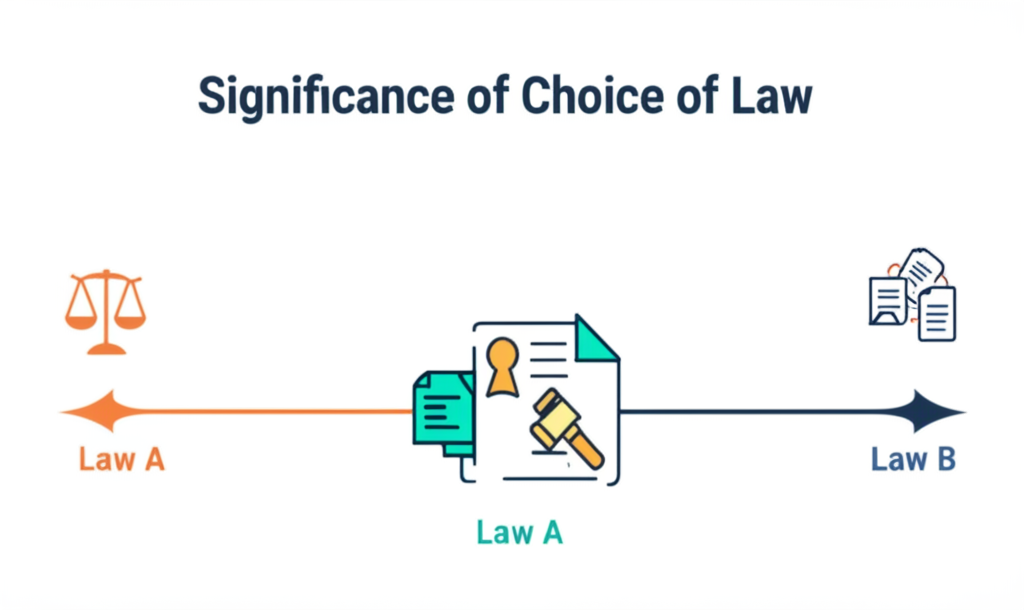
In any legal dispute, the substantive laws applied can dramatically alter the outcome. Consider a contract dispute between a French company and a German company. Should the court apply French contract law, German contract law, or perhaps the law of a third country where the contract was to be performed? The differences can be substantial, affecting issues like:
- Contract validity: Requirements for a valid contract.
- Interpretation of terms: How ambiguous clauses are understood.
- Remedies for breach: Available damages or specific performance.
- Statute of limitations: Time limits for bringing a claim.
Without a clear mechanism for determining the applicable law, cross-border transactions would be fraught with uncertainty, hindering international trade and cooperation. The choice of law rules aim to provide this much-needed certainty.
Key Principles Guiding Choice of Law
While specific rules vary between legal systems, several overarching principles guide the choice of law determination in private international law:
Party Autonomy: The Freedom to Choose
One of the most fundamental principles is party autonomy. This principle recognizes the right of parties to choose the law that will govern their contractual relationship. In many jurisdictions, particularly in commercial matters, parties are free to stipulate in their contract which country’s law will apply. This is often done through a choice of law clause or governing law clause.
- Benefits of Party Autonomy: It promotes certainty, predictability, and allows parties to select a legal system with which they are familiar or that they deem most suitable for their transaction. For example, a U.S. company might prefer to have its contract with a Japanese entity governed by U.S. law if it is more favorable to its business practices.
- Limitations: Party autonomy is not absolute. Courts may disregard a chosen law if it violates the mandatory rules of the forum (the court hearing the case) or a country with which the dispute has a closer and more appropriate connection. Public policy considerations also play a role.
Closest Connection Test
When parties have not made an express choice of law, or when their choice is deemed invalid, courts will typically apply the law of the country with the closest connection to the dispute. This involves a factual analysis to identify the jurisdiction that has the most significant relationship with the parties and the transaction.
Factors considered in determining the closest connection often include:
- The place where the contract was negotiated and concluded.
- The place of performance of the contract.
- The domicile or habitual residence of the parties.
- The location of the subject matter of the contract (e.g., property).
- The place where the tortious act occurred (in tort cases).
Lex Fori: The Law of the Forum
In some instances, particularly in procedural matters or when no other connection is strong, courts may apply the lex fori, which is the law of the country where the court is located. This is often the default rule for procedural aspects of a case, such as rules of evidence or court procedures.
Lex Loci Delicti: Law of the Place of Tort
For tortious claims (civil wrongs), the traditional approach was to apply the lex loci delicti, the law of the place where the tort was committed. However, modern approaches often incorporate flexibility, considering the law of the place where the harm occurred or the law with the closest connection if it leads to a more just outcome.
Lex Situs: Law of the Place of Property
Disputes involving immovable property (land and buildings) are almost universally governed by the lex situs, the law of the place where the property is located. This is due to the sovereign nature of states over their territory and the need for consistent rules regarding land ownership and transfer.
Choice of Law in Contractual Disputes

Contractual disputes are perhaps the most common scenario where choice of law issues arise. As mentioned, party autonomy is a dominant principle here.
The Role of Choice of Law Clauses
A well-drafted choice of law clause is crucial for businesses engaged in international trade. It clearly designates the governing law, minimizing ambiguity and potential disputes over which legal system should apply. For example, a clause might state: “This Agreement shall be governed by and construed in accordance with the laws of the State of New York, without regard to its conflict of laws principles.”
Importance of Specificity: It is advisable to specify the jurisdiction and explicitly state whether or not to include its conflict of laws rules. Excluding them often leads to the application of the chosen jurisdiction’s substantive* law, avoiding a further layer of choice of law analysis.
Absence of a Choice of Law Clause
If parties fail to include a choice of law clause, courts must determine the applicable law using established conflict of laws principles. For contracts, this often involves the closest connection test.
- Restatement (Second) of Conflict of Laws: In the United States, the Restatement (Second) of Conflict of Laws provides a widely influential framework for determining the applicable law in the absence of a party’s choice. It emphasizes identifying the state with the “most significant relationship” to the transaction and the parties.
- Rome I Regulation (European Union): Within the EU, the Rome I Regulation (Regulation (EC) No 593/2008) provides a harmonized set of rules for determining the law applicable to contractual obligations in civil and commercial matters. It prioritizes party choice but also sets out default rules based on the characteristic performance of the contract.
Choice of Law in Tort Disputes
Tort disputes, involving civil wrongs like negligence, defamation, or product liability, present different challenges for choice of law.
Traditional vs. Modern Approaches
- Traditional Approach: The lex loci delicti (law of the place where the wrong occurred) was the traditional rule. This offered certainty but could lead to harsh outcomes if the place of the wrong had little connection to the parties or the harm suffered.
- Modern Approaches: Many jurisdictions have moved towards more flexible approaches, often considering the law of the place where the injury occurred or the law with the most significant connection. The Second Restatement of Conflict of Laws in the U.S., for instance, uses an “most significant relationship” test for torts as well.
Specific Considerations in Torts
- Defamation: Laws regarding defamation vary significantly. The applicable law might depend on where the defamatory statement was published or where the plaintiff suffered reputational harm.
- Product Liability: For defective products, courts might consider the law of the place of manufacture, the place of sale, or the place where the injury occurred.
Choice of Law in Other Areas
Beyond contracts and torts, choice of law principles apply to various other legal domains:
Family Law
Matters like marriage, divorce, adoption, and child custody can involve complex choice of law issues. The applicable law might be determined by the domicile, habitual residence, or nationality of the parties involved.
Succession (Wills and Estates)
Disputes concerning inheritance and the distribution of a deceased person’s assets typically involve the law of the deceased’s domicile at the time of death for movable property, and the lex situs for immovable property.
Property Law
As mentioned, immovable property is governed by the lex situs. For movable property, the applicable law can be more complex, often depending on whether the property is tangible or intangible and the circumstances of its transfer.
Factors Influencing Choice of Law Decisions
When a court is tasked with determining the applicable law, several factors can influence its decision:
Public Policy (Ordre Public)
No legal system will enforce a law that is fundamentally contrary to its own public policy. Even if a foreign law is chosen or indicated by conflict rules, a court may refuse to apply it if doing so would violate the forum’s basic notions of justice and morality.
Mandatory Rules
Certain laws are considered mandatory rules because they are deemed essential for safeguarding public interests, economic, or political policies of a state. These rules apply regardless of the law that would otherwise govern a situation. For example, competition law or certain labor protection laws might be considered mandatory.
Forum Shopping
Forum shopping is the practice of litigants seeking out a court perceived to be more favorable to their case, not only in terms of jurisdiction but also in terms of the applicable law. Courts are generally vigilant against blatant forum shopping and may refuse jurisdiction or apply a different choice of law if the forum has no real connection to the dispute.
International Conventions and Treaties
International agreements play a significant role in harmonizing choice of law rules. Conventions like the Hague Conventions aim to provide uniform rules for conflict of laws in specific areas, such as international child abduction or the law applicable to certain commercial contracts.
- Example: The 1986 Hague Convention on the Law Applicable to Commercial Agency provides uniform rules for determining the law governing commercial agency contracts.
Challenges in Choice of Law
Determining the applicable law in cross-border disputes is not without its difficulties:
Complexity and Uncertainty
Even with established rules, the application of private international law principles can be complex and lead to uncertainty, especially in novel or intricate factual scenarios.
Differing Legal Systems
The fundamental differences between common law and civil law systems, or variations within these broad categories, can make the application of foreign law challenging.
Evidentiary Issues
Proving foreign law can be difficult and expensive. Courts typically require expert testimony or certified translations to understand and apply foreign legal provisions.
The Role of Technology
In the digital age, issues like data privacy, online contracts, and cybercrimes introduce new complexities. Determining jurisdiction and applicable law for online activities requires careful consideration of factors like server location, user location, and data flow.
The Importance of Legal Counsel
Given the intricate nature of private international law and choice of law determinations, seeking expert legal advice is paramount for individuals and businesses involved in cross-border transactions or disputes.
- Preventive Measures: Experienced lawyers can help draft robust choice of law clauses in contracts, minimizing future conflict.
- Navigating Disputes: In the event of a dispute, legal counsel can navigate the complexities of identifying the applicable law and advocating for the most favorable legal framework.
Conclusion
The choice of law is a cornerstone of private international law, providing the essential framework for resolving legal disputes that transcend national borders. Whether through the party autonomy of a meticulously drafted contract clause or the court’s application of closest connection principles in the absence of such a clause, the goal remains consistent: to ensure fairness, predictability, and the effective administration of justice in an increasingly interconnected world. Understanding these principles is not merely an academic exercise; it is a practical necessity for anyone engaging in international commerce or facing cross-border legal challenges.
Frequently Asked Questions (FAQs)
What is the primary goal of choice of law rules?
The primary goal is to determine which country’s substantive laws will govern a legal dispute with a foreign element, ensuring predictability and fairness.
Can parties always choose the law that governs their contract?
Generally, yes, through party autonomy. However, this choice may be overridden if it violates the mandatory rules or public policy of the forum or a country with a closer connection.
What happens if parties do not specify a choice of law in their contract?
If no choice of law is specified, courts will apply conflict of laws rules to determine the law of the country with the closest connection to the contract or dispute.
How does ‘lex fori’ differ from ‘lex loci delicti’?
Lex fori is the law of the court’s location, often used for procedural matters. Lex loci delicti is the law of the place where a tort (civil wrong) occurred, a traditional rule for tort disputes.
Are there international agreements that standardize choice of law?
Yes, international conventions, such as the Hague Conventions, aim to create uniform choice of law rules for specific types of disputes or transactions.
Why is public policy an exception to party autonomy?
Public policy (ordre public) acts as an exception because no country will enforce a foreign law that fundamentally violates its core legal principles and societal values.
External Resources
- The Hague Conference on Private International Law: https://www.hcch.net/
- UNIDROIT (International Institute for the Unification of Private Law): https://www.unidroit.org/
- European Union Agency for Fundamental Rights (FRA) – Private International Law: https://fra.europa.eu/en/themes/private-international-law (Note: While FRA focuses on fundamental rights, their work often intersects with PIL, especially concerning cross-border family law and civil matters.)
