

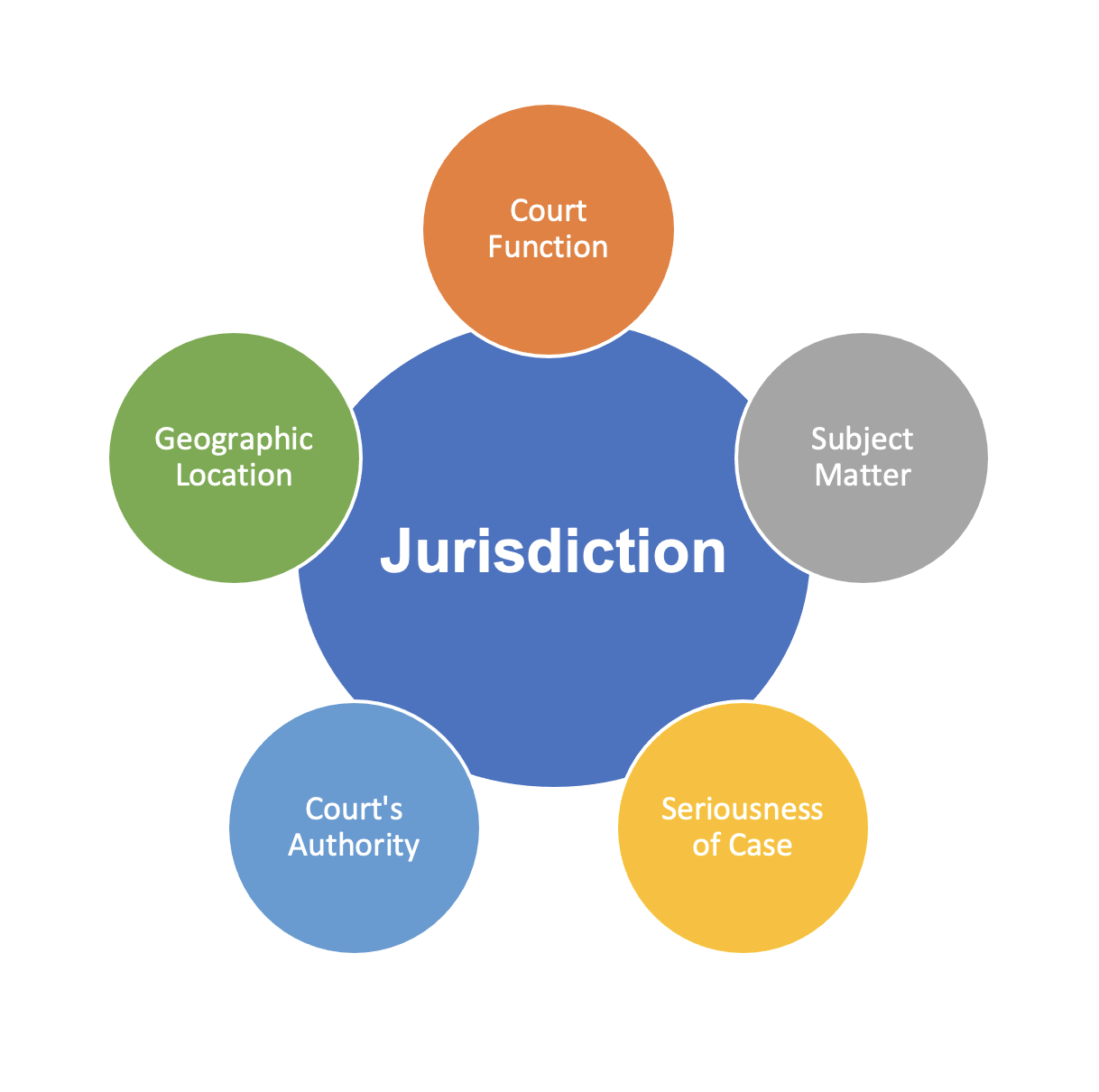

Jurisdiction is the framework that gives courts and legal authorities the power to act. While the term is often used broadly, it actually includes several distinct types, each serving a specific role in determining how and where legal cases are handled. Understanding these types helps clarify why some courts can hear certain cases while others cannot, even if they are located nearby.
This article explains the three main types of jurisdiction—territorial, personal, and subject matter—in clear language, with practical examples that show how they operate in everyday legal situations. It is written for beginners, students, and general readers seeking a foundational understanding of legal authority.
Why Jurisdiction Is Divided Into Types
Legal systems handle a wide range of disputes, from minor civil claims to serious criminal cases and complex commercial litigation. Dividing jurisdiction into categories helps assign cases to the appropriate authority.
Each type of jurisdiction answers a different question:
- Territorial jurisdiction asks, where did this happen
- Personal jurisdiction asks, who is involved
- Subject matter jurisdiction asks, what kind of legal issue is this
Together, these elements ensure that cases are handled fairly, efficiently, and within legal limits.
Territorial Jurisdiction Explained
Territorial jurisdiction is based on geography. It determines which court or authority has the power to hear a case based on where an event occurred or where a dispute is connected.
How It Works in Practice
If a legal issue arises in a particular city, district, or state, the courts in that area usually have territorial jurisdiction. This principle helps keep legal matters local and relevant to the laws of that region.
For example, if a property dispute involves land located in a specific district, the courts in that district generally handle the case. The same applies to most criminal matters, letting local courts apply regional laws and procedures.
Why Territorial Jurisdiction Matters
Territorial jurisdiction helps avoid confusion and legal conflict between courts. Without it, multiple courts might try to hear the same case, leading to inconsistent rulings.
It also protects individuals from being forced to defend themselves in distant or unrelated locations, which could create unfair burdens.
Exceptions and Special Situations
Some cases do not fit neatly into one geographic area. Examples include online disputes, cross border transactions, or offenses that occur in more than one location.
In these situations, courts examine which location has the strongest legal connection. This may include where the impact was felt, where the parties reside, or where key actions took place.
Personal Jurisdiction Explained
Personal jurisdiction focuses on the authority a court has over the individuals or organizations involved in a case. It ensures that a court does not exercise power over someone who has no meaningful connection to that region.
What Creates Personal Jurisdiction
Courts usually establish personal jurisdiction based on factors such as:
- Residency or citizenship
- Physical presence in the region
- Business operations within the region
- Agreements that specify a legal forum
These connections help justify why a court has authority over a person or company.
Practical Example
If a company regularly sells products in a particular state or country, courts in that region may have personal jurisdiction over the company, even if its headquarters are located elsewhere.
This principle ensures that businesses cannot avoid legal responsibility simply by operating from a distant location.
Limits of Personal Jurisdiction
Courts cannot automatically claim authority over anyone who interacts with a region in a minimal way. For example, a single online purchase may not be enough to establish personal jurisdiction.
Judges often examine whether the person or business intentionally engaged with the region in a meaningful and ongoing manner.
Subject Matter Jurisdiction Explained
Subject matter jurisdiction refers to a court’s authority to hear a specific type of legal case. Not all courts are equipped to handle every kind of legal issue.
Specialized Courts and Legal Authority
Some courts focus on criminal law, while others handle civil disputes, family matters, tax cases, or administrative issues. This specialization allows judges to develop expertise in particular areas of law.
For example, a family court typically cannot hear a serious criminal trial, just as a criminal court may not handle complex tax disputes.
Why Subject Matter Jurisdiction Is Critical
If a court lacks subject matter jurisdiction, any decision it makes may be considered invalid. This means the case may need to be restarted in the proper court.
This requirement ensures that legal matters are handled by authorities with the appropriate legal mandate and procedural rules.
How the Three Types Work Together
In most cases, all three types of jurisdiction must be satisfied for a court to proceed.
A court must:
- Be located in the right place
- Have authority over the people or entities involved
- Be authorized to hear that type of case
If any of these elements are missing, the case may be dismissed or transferred.
Example in a Civil Case
Imagine a contract dispute between two companies.
- Territorial jurisdiction: The court is in the region where the contract was signed or performed.
- Personal jurisdiction: The court has authority over both companies because they operate in that region.
- Subject matter jurisdiction: The court is authorized to hear commercial or civil disputes.
Only when all three apply can the court move forward.
Example in a Criminal Case
In a criminal matter:
- Territorial jurisdiction: The crime occurred within the court’s geographic area.
- Personal jurisdiction: The accused is within the reach of the court’s legal authority.
- Subject matter jurisdiction: The court is authorized to hear criminal cases of that level.
This structure ensures lawful and orderly prosecution.
Jurisdiction in International Contexts
When cases involve parties from different countries, all three types of jurisdiction become more complex.
Courts may rely on treaties, international agreements, and principles of fairness to decide whether they can hear a case.
In some situations, more than one country may claim jurisdiction, requiring coordination or legal negotiation.
Common Misunderstandings
One common mistake is assuming that location alone determines jurisdiction. In reality, personal and subject matter elements are equally important.
Another misunderstanding is believing that a court can hear a case simply because one party wants it to. Legal authority must be established first.
Understanding these points helps avoid procedural errors.
Why Jurisdiction Knowledge Is Useful
For individuals, knowing about jurisdiction helps in understanding where legal rights can be enforced.
For businesses, it influences decisions about where to operate, how to structure contracts, and how to manage legal risk.
This knowledge supports better planning and fewer surprises.
When to Seek Professional Guidance
Jurisdictional questions can become complex, especially in cross border or high value cases. Professional legal advice can clarify which courts have authority and how to proceed.
This article provides general information and does not replace legal counsel.
Final Thoughts
Territorial, personal, and subject matter jurisdiction work together to define the boundaries of legal authority. Each plays a distinct role in ensuring that cases are heard by the right court, in the right place, and for the right reasons.
Understanding these types of jurisdiction provides a clearer picture of how legal systems maintain order and fairness, both locally and across borders.
Also Read: What is jurisdiction in law definition and examples
